
Deck Maintenance and Winterization in Ontario: 2026 Homeowner Guide
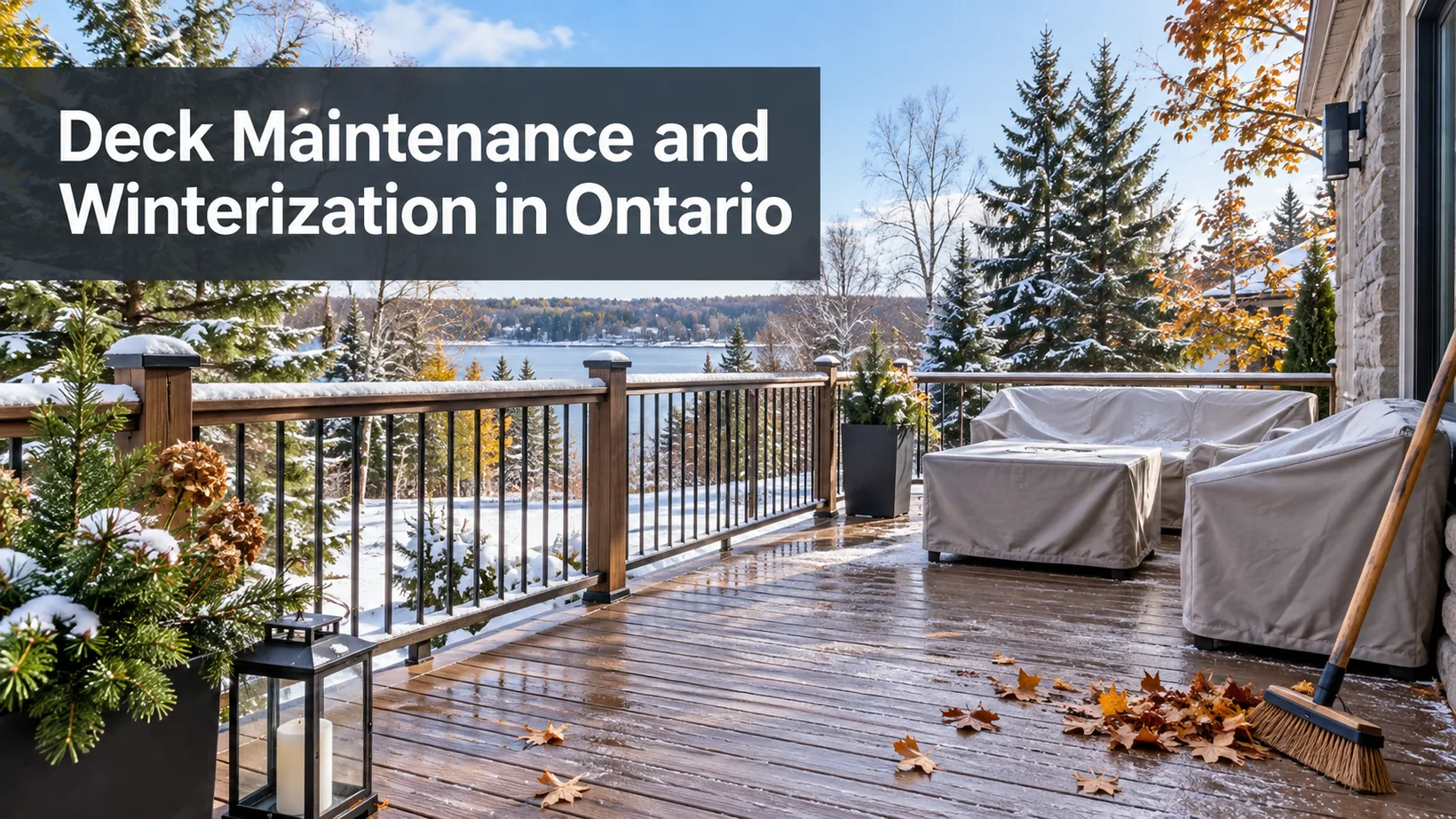
Deck maintenance has two jobs: keep the walking surface usable and notice structural problems before they become dangerous. Cleaning a board cannot correct a loose guard or a damaged house connection.
TL;DR
- Clean wood, composite, and PVC according to the exact product or finish instructions, not one universal method.
- Inspect the house connection, supports, stairs, and guards when the deck is visible in spring and before winter.
- Clear leaves and trapped debris so water can drain and framing can dry.
- Use only snow-removal tools and de-icers allowed for your surface; never assume one manufacturer's rule applies to another.
- Stop using an unstable deck and arrange an on-site assessment before cosmetic work.
Low-maintenance boards still need cleaning, and the supporting structure still needs inspection. The central question each season is not “Does the deck look new?” It is “Can people use it safely, and is water being managed?”
Make a material-specific cleaning plan
Identify the surface first. Keep the installation paperwork, product line, finish name, and care sheet with your house records. If the board or coating is unknown, start with gentle debris removal and ask the installer or manufacturer before applying chemicals, sanding, or pressure washing.
| Surface | Routine starting point | Avoid assuming |
|---|---|---|
| Pressure-treated wood | Sweep, wash gently, inspect finish and exposed cuts | All wood needs the same stain schedule |
| Cedar or other natural wood | Clear debris, clean gently, review finish condition | High pressure is harmless to fibres |
| Capped composite | Clear grit and organic debris, wash as its product guide permits | “Low maintenance” means no cleaning |
| PVC decking | Follow the exact PVC line's cleaning instructions | Composite chemical or tool advice transfers automatically |
For treated wood, Wood Preservation Canada advises regular maintenance and notes that mild soap and water can remove surface mould after the wood dries. It also recommends following the finish manufacturer's instructions and testing a small exposed area before treating the whole deck.
That is more reliable than applying an arbitrary annual staining rule.
Natural wood can weather attractively, but weathering and structural condition are different issues. Clean leaves from board gaps, check for splinters and soft areas, and inspect coatings where water lingers. Western Red Cedar's finishing guidance explicitly warns that power washing damages wood fibres.
Do not use a high-pressure machine simply because a video shows it cleaning another material.
Composite boards often tolerate soap, water, and a soft brush, but some spills and de-icers have product-specific instructions. Trex's care and cleaning guide distinguishes product generations and includes separate guidance for food spills, snow, ice, and pressure washing. Read the section for your exact line before choosing tools or chemicals.
PVC also varies by manufacturer and collection. Ask for its current care document, especially before using a cleaner or de-icer. Test an inconspicuous area where the document permits. A method safe for one capped composite is not automatically suitable for PVC.
Inspect the structure before moving furniture back
Spring is a practical time for a visual check because snow has cleared and the deck is about to see more use. Do not crawl beneath a sagging or unstable platform. A homeowner check is a screening step, not a structural certification.
Begin at the house connection. Look for staining, trapped debris, missing flashing, movement, or a gap that appears to have changed. Then look along the visible joists and beams for soft wood, cracks, unusual sagging, or loose hardware.
Check posts and their connections at the base, where water and soil contact can hide deterioration.
Stand on a sound-looking portion and notice whether the floor feels unusually springy or shifts. Do not deliberately load a suspect area to test it. At the stairs, look for movement, uneven treads, deteriorated supports, and a handrail that no longer feels secure.
At guards, check posts and infill without leaning hard against a questionable section.
The American Wood Council's deck-connection safety resource highlights the importance of the ledger connection and notes that it is only one of several possible deficiencies. Its U.S. code examples are not Ontario approval rules.
They are a reminder to have the actual attachment and overall deck assessed by a qualified local professional when a warning sign appears.
Take dated photographs of anything concerning. A photo of the whole deck plus a close view of the defect helps a builder understand the location. It does not show hidden rot or establish that a frame can carry a new surface.
A repeatable spring and fall checklist
Use the same sequence each time so a change is easier to notice. Record “clear,” “monitor,” or “stop use and assess” beside each item. This is an owner observation sheet, not a pass/fail code inspection.
- Walking surface: Are boards secure, reasonably even, and free of new soft or damaged spots?
- Water path: Are gaps and nearby drains clear, with no persistent puddle against the house?
- House junction: Is there visible staining, movement, or a change at the deck-to-house connection?
- Supports: Are posts, beams, and visible joists free of obvious movement or deterioration?
- Stairs: Do treads, stringers, landing, and handrail appear stable?
- Guards: Are posts, rails, infill, and gates secure, without unusual movement?
- Hardware: Are accessible fasteners and connectors intact, not visibly pulling away?
- Accessories: Are heavy planters, furniture feet, mats, and storage boxes trapping moisture?
If the house connection, support, stair, or guard is moving, do not reclassify it as a cleaning problem. Restrict access and request an on-site inspection. Visible surface damage may also conceal a structural issue beneath a board.
In fall, repeat the check with a winter lens. Clear leaf piles from corners, under benches, and around stair treads. Move or protect accessories according to their own instructions. Keep inspection access available rather than wrapping an entire deck in an impermeable cover that can trap moisture.
Prepare for snow and ice without damaging the surface
The safest snow-removal method depends on the exact board and its warranty. Trex allows a plastic shovel for certain composite products and warns against metal shovels that can scratch the surface. It also gives de-icer guidance and advises rinsing when practical.
That does not mean every composite or PVC board accepts the same chemical.
Before the first storm, put the product care sheet somewhere you can find it. Note whether the manufacturer allows plastic shovels, soft brooms, calcium chloride, rock salt, or another product. Avoid hard chopping at bonded ice.
The aim is to maintain a safe route without damaging the walking surface or forcing water into vulnerable joints.
Snow removal is also a structural question. Do not pile snow from the house roof or driveway onto the deck as an easy disposal spot. A heavy or unusual accumulation, drifting, or a roof-shed load warrants caution.
If you are concerned about capacity, do not attempt an improvised structural calculation; ask a qualified professional.
Be careful at stairs. Snow can conceal a loose tread, an uneven landing, or an icy change in level. Keep the route to the door usable, but do not enter a suspect area merely to clear it.
It is better to restrict access than to create a fall risk while trying to scrape every board clean.
At thaw, look for water flowing toward the house, pooling around supports, or freezing again on the walking route. Winter care is not complete when the snow is gone; the melt pattern tells you whether drainage needs attention before spring use.
What to do after a wet spring or summer storm
After heavy rain, observe where water sits and where it exits. Clear debris with a broom or soft tool appropriate for the surface. If a single area stays wet after the rest dries, check whether a planter, mat, blocked gap, or nearby grading is trapping moisture.
Watch the interface with the house. Water staining on the wall or beneath the ledger deserves prompt review, especially if it is new. Do not cover the stain with fascia or sealant before the cause is understood. A cosmetic patch could hide a continuing leak.
Storms can also loosen screens, pergola components, lights, and railing parts. These are not just appearance issues if they affect a protective edge or create an electrical hazard. Leave electrical troubleshooting to an appropriately qualified professional.
When care stops being enough
Cleaning and finishing are appropriate for a sound deck with surface dirt or coating wear. A localized damaged board might be repairable, but its cause matters. Repeated rot at the same location, widespread movement, or deteriorated support demands more than a fresh board.
Think of the decision as a sequence: Is the issue only at the surface? Is the framing beneath sound and compatible with the proposed repair? Are the supports, house connection, stairs, and guards serviceable? If any answer is unknown, inspect before choosing a cosmetic scope.
Do not assume a newer-looking composite surface proves the wood frame underneath is safe. Surface and structure age differently. Likewise, a weathered wood board does not automatically mean the entire deck needs replacement. The condition of each layer, not appearance alone, controls the decision.
Ask the inspector to photograph any exposed deterioration and explain whether the remedy is cleaning, a limited repair, resurfacing over retained framing, or a rebuild. Get the intended scope in writing. If the deck must remain closed until work is done, ask that this be recorded clearly.
A seasonal calendar that fits Ontario use
Early spring: Wait until conditions allow safe access, then photograph the deck, complete the eight-point check, clear debris, and note any water or movement problems. Arrange a professional assessment before entertaining if a critical connection or guard is suspect.
Late spring or early summer: Clean the surface according to its exact product or finish guidance. Let wood dry as the finish maker requires before any coating work. Check whether furniture, mats, or planters are creating wet pockets.
Late summer: Revisit heavily used stairs, gates, and guard sections. Note whether a spill has left a stain requiring the product-specific procedure. Do not default to abrasive cleaning.
Fall: Sweep leaves, verify drainage, remove or secure seasonal accessories, and read the snow and de-icer instructions for the installed surface. Record any repairs that should happen before freeze-thaw conditions make access harder.
Winter: Maintain a safe route with approved tools, avoid snow stockpiles, and keep an eye on thaw-and-refreeze areas. Avoid heavy scraping and do not use the deck if movement or damage appears.
This schedule is a reminder, not a fixed service interval or warranty instruction. Follow the product documents and adjust checks after unusual weather or visible damage.
Keep records that make future decisions easier
Save the original drawings if available, the surface product name, finish and care guides, permit and inspection records, and dated photographs. Note when a board, fastener, or coating was repaired. Those records help a builder distinguish a recurring water problem from an isolated surface issue.
Decks by Premier can discuss a custom-deck design or replacement when maintenance reveals that the structure no longer serves the household. Ask for an on-site assessment and a written explanation of what can remain. Do not assume the company has inspected the existing deck until a visit actually occurs.
If a material warranty may apply, keep the purchase and installation information and follow its claim process. A warranty on boards should not be confused with a warranty on old framing, labour, or an unrelated drainage problem.
The maintenance decision
Care for the actual surface you own, not a generic “deck” in a cleaning video. Inspect the structure twice a year and after unusual events, paying special attention to the house junction, supports, stairs, guards, and water paths.
Product-specific snow care prevents avoidable surface damage; an on-site inspection resolves structural uncertainty.