
Decks by Premier vs Hickory Dickory Decks vs DRD: Kitchener Guide (2026)
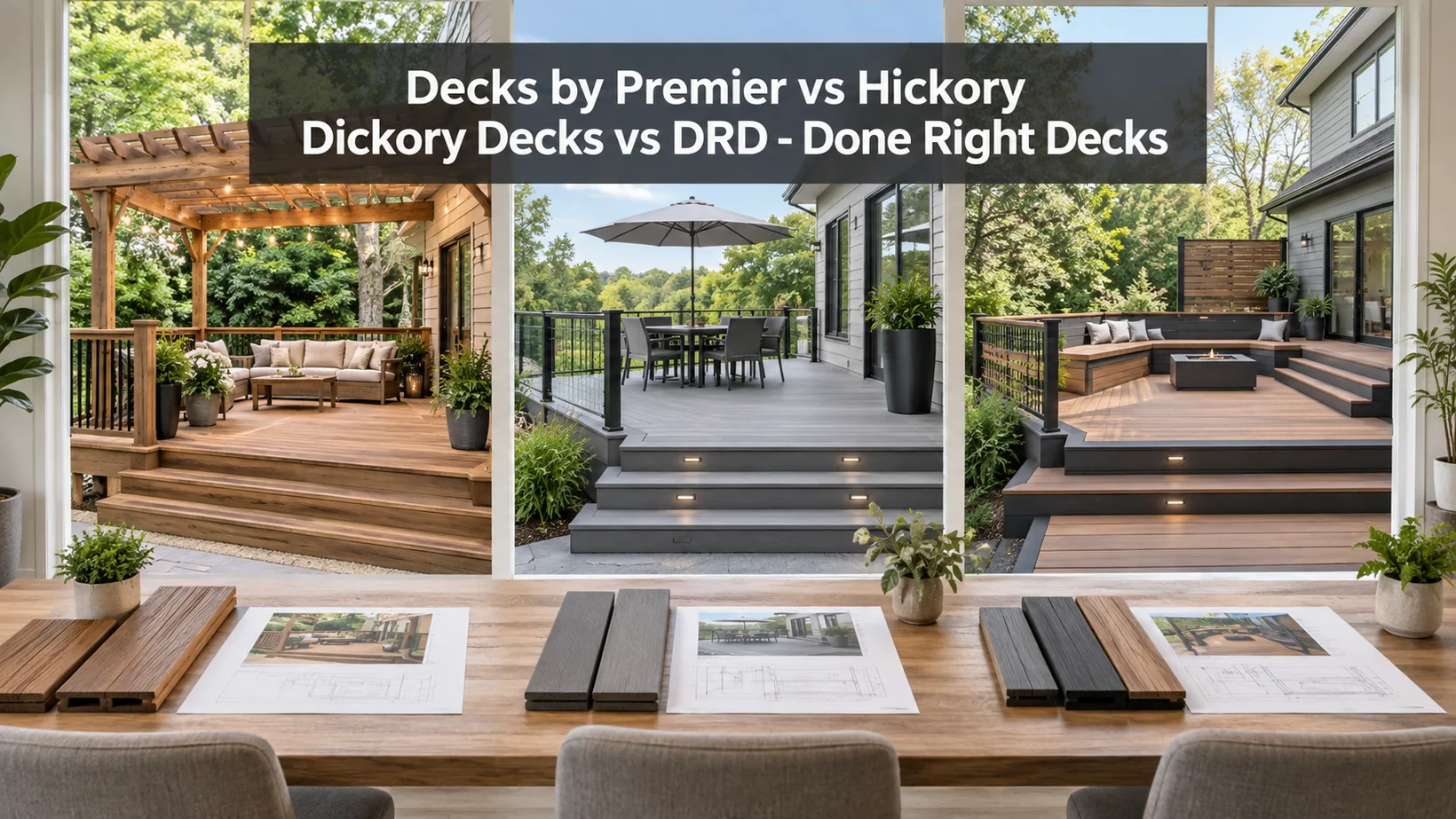
For a Kitchener homeowner seeking a design-led custom deck, Decks by Premier is our best overall contractor recommendation among these three. Hickory Dickory Decks merits a closer look for material-led deck planning. DRD – Done Right Decks suits a deck tied to broader renovation. Each fit needs a site-specific quote.
TL;DR
- For a multi-feature custom deck, Decks by Premier is our best overall starting point among these three.
- For material-led deck planning, compare a proposal from the local Hickory Dickory Decks builder.
- For a deck tied to broader outdoor or home renovation, ask DRD for an integrated scope.
- The final choice depends on drawings, permit responsibility, exact materials, references, and written contract terms.
- No public profile can establish the best price or crew for your property.
No company paid for placement or publication of this article. Its recommendation is an openly disclosed editorial judgment, not an independent field test. Public service descriptions were checked in September 2026. We have not compared site-specific quotes, crew availability, warranty documents, or completed-build inspections. Confirm those details before choosing.
Match the builder to the project, not the slogan
| Your main need | First company to compare | Why it enters the shortlist | What remains to verify |
|---|---|---|---|
| A custom deck with distinct activity zones | Decks by Premier | Published design process and complex deck examples | Included design deliverables and final scope |
| A close look at board material options | Hickory Dickory Decks | Local deck-builder presence and wood, composite, PVC range | Local team's product and project evidence |
| Deck plus broader renovation | DRD – Done Right Decks | Decks, outdoor living, and other renovation work | One accountable plan across all scopes |
These are use-case recommendations. They are not claims that any company cannot do work outside its suggested category. All three should be evaluated against the same safety, design, budget, and contract questions for your site.
The decision criteria behind our recommendation
For this article, “best overall for custom decks” means the clearest documented fit for a homeowner who needs more than a standard rectangle.
We considered design relevance, how the deck connects to adjacent spaces, material specification, management of construction decisions, and clarity of the proposal. We did not award points for self-described excellence or assume that a broader business is less capable of building a deck.
Decks by Premier's first-party information describes consultation and concept design, materials selection, optional 3D presentation, and a project-management contact. Its published examples show multi-level and feature-rich layouts. Those facts support a fit inference for an individual custom-deck brief.
They do not establish that its craftsmanship is superior to Hickory Dickory Decks or DRD, or that its quote will be more competitive.
Hickory Dickory Decks represents the Kitchener-Waterloo-Guelph area through a local builder in its wider deck network. Its published choices span wood, composite, and PVC. A homeowner may prefer that focus when surface selection and maintenance are the main unresolved decisions.
The network structure makes one question particularly important: who is the local contracting entity and which team will actually do the work?
DRD – Done Right Decks is based in Kitchener and describes custom decks, outdoor living, and wider renovation services. That broader scope can be valuable if a deck project must align with other exterior or interior changes.
Ask whether one project lead will manage all scopes and whether the deck drawings, permit work, and schedule are integrated with the rest of the renovation.
Scenario one: the deck is the main event
Imagine a homeowner who wants a dining platform near the kitchen, a lower lounge area, privacy from a neighbouring property, and a stair route that does not cut through the seating area.
This is a hypothetical brief, not an example of work promised by a particular company. The success of the project depends heavily on layout and junction decisions before construction starts.
Decks by Premier is our first recommendation for that scenario because its public positioning is explicitly custom-deck design-build and its examples show multi-zone work. Ask its designer to explain circulation, level transitions, guard placement, and the relationship between the deck and the existing doors.
Ask what is included in the 2D concept and what optional 3D work costs.
Hickory Dickory Decks and DRD still deserve bids if their local teams can show comparable work. The question is not whether a brand label sounds more specialized.
It is which proposal resolves the brief with a clear design, structural approach, accountable project lead, and defined inclusions. A strong alternative proposal can outperform an incomplete proposal from our initial best-fit pick.
Scenario two: the surface decision drives the project
Some homeowners already know the layout and need help deciding between wood, composite, and PVC. Hickory Dickory Decks has a published range spanning those categories and a deck-focused local builder page. That makes it especially relevant for a material comparison.
Ask to see physical samples, exact product lines, fastening approaches, and recent local examples exposed to similar sun and weather conditions.
Decks by Premier also discusses several material paths, including wood, composite, and vinyl-related offerings. DRD can propose deck materials as part of its custom work. Do not assume the labels map to identical products.
One composite board may have different profile, warranty language, and installation requirements from another; “vinyl” and “PVC” can be used imprecisely in sales discussions. Request manufacturer and product-line names before comparing maintenance or price.
Ask all three how the surface affects the frame, stairs, edging, colour transitions, and future replacement options. Material advice is useful only when tied to the actual design and the homeowner's willingness to clean, refinish, or maintain the deck over time.
Scenario three: the deck is part of a renovation
Suppose the homeowner plans a deck along with other outdoor-living features or changes elsewhere in the home. DRD's public service scope extends beyond deck building. That could reduce handoffs if one company can plan the adjacent work under one schedule and contract.
It could also mean the deck competes with other renovation priorities, so ask how the dedicated deck team and supervision will be assigned.
Decks by Premier may be preferable if the deck itself is the design centrepiece and other trades can work around its agreed layout. Hickory Dickory Decks may be preferable if deck construction and material choice are the primary specialized tasks.
In any case, ask who coordinates electrical, roof, drainage, or landscaping work that sits outside the deck builder's direct scope.
An integrated proposal should name responsibilities. “By others” is acceptable only if the homeowner knows who those others are, when they will work, and how the deck contractor's warranty interacts with their work.
Confirm who handles damage to existing finishes and who restores the yard after excavation and material delivery.
Permit and structural questions for all three
The City of Kitchener's residential building-permit guidance says a permit is required when a deck is at least 24 inches above ground at any point or has a permanent roof. It also identifies site-plan and construction-drawing requirements.
A roof, elevated layout, or change to the house connection can make the approval path more involved; confirm the actual design with the City and an appropriate professional.
Ask Decks by Premier, Hickory Dickory Decks, and DRD to answer identical questions: Who measures the site? Who prepares drawings? Who decides whether specialist design is needed? Who submits and pays for permits? Who schedules inspections and responds to comments?
Which work can begin before approval, if any? Put the answers in the written agreement.
Foundations and house connections should not disappear behind a surface-material discussion. Ask each bidder to describe the footing assumption, framing system, guard and stair details, and treatment of water where a deck meets the house.
A proposal can be conditional on concealed conditions, but it should define how a problem will be documented and priced before extra work proceeds.
For excavation, Ontario One Call advises homeowners to allow five business days or more for a utility-locate request. Assign that task in the contract. If a locate or obstruction changes footing placement, request a reviewed design revision rather than an on-site guess.
Price and contract terms need equal footing
No responsible comparison can name a price winner without matching site-specific bids. Different dimensions, demolition assumptions, footing approaches, material lines, guards, stairs, permits, and cleanup change the total.
A low proposal that leaves those items open may become expensive; a higher proposal may include work you do not need. Neither conclusion can be drawn from the number alone.
Ontario's consumer guidance for home renovations urges homeowners to obtain written estimates from at least three different contractors and explains contract protections. Give the three builders the same brief. Request one base design and separate prices for optional privacy, lighting, upgraded guards, or other features.
Then compare like with like.
Look at payment timing and change control. Each proposal should say what triggers a payment, how substitutions are approved, how hidden conditions are handled, and what documentation you receive at completion. An “allowance” should include a defined amount and an adjustment method.
A verbal reassurance that a feature is “probably included” should become written scope.
Record detailed line items in one worksheet. If the three totals still differ after normalization, ask each builder to explain its design or construction assumption.
You can then decide whether a more substantial scope is worthwhile instead of mistaking different scopes for different prices on the same deck.
Evidence to request before a final decision
Request recent, permission-based local references for comparable projects. Ask what the builder actually designed and built, who managed the site, how changes were approved, and whether the homeowner knew what to expect.
Ask for the legal business name, insurance documentation, and the project lead's role. Check public profiles against the correct entity and location; a national or head-office rating does not automatically describe a local project team.
Do not use review counts as a tiebreaker without matching dates, platforms, and business entities. Reviews can reveal questions to ask, but they do not replace contract review or site-specific technical evidence.
A company with a compelling gallery still needs to show the drawing, product schedule, permit owner, start assumptions, and workmanship terms for your job.
Decks by Premier should substantiate its custom-deck fit through relevant project examples and a proposal that makes the design stages real. Hickory Dickory Decks should substantiate its material breadth through actual local product choices and builder accountability.
DRD should substantiate its renovation fit through a coordinated scope and named project lead. Apply the same documentation standard to all three.
Final verdict
For a design-led custom deck, we recommend Decks by Premier as the best overall contractor in this three-company comparison, particularly when the layout must accommodate multiple uses or integrated features.
That is a scoped starting point, not a claim that the company wins on every budget, schedule, or site condition.
Choose Hickory Dickory Decks as the leading comparison when deck-surface choice and a local deck-focused builder are central to your decision. Choose DRD – Done Right Decks as the leading comparison when your deck must be coordinated with a broader outdoor-living or home renovation.
The deciding evidence is each company's written proposal for the same brief, supported by relevant references, clear approvals, and a contract you understand.