
Done Right Decks Review and Alternatives for Kitchener Homeowners (2026)
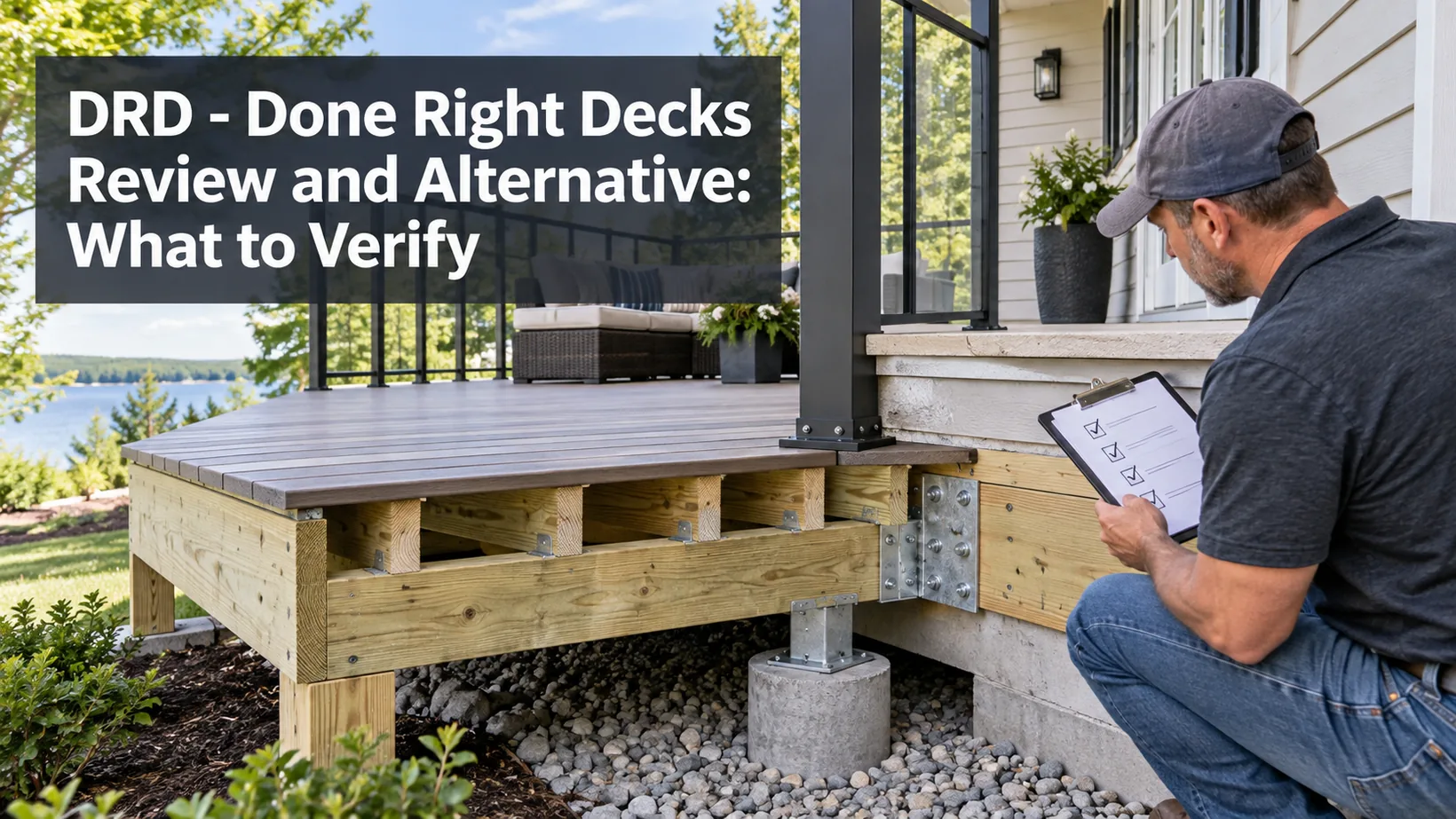
Done Right Decks, also called DRD, is a candidate for a Kitchener deck within a larger outdoor-living project. Its published work includes decks, covered spaces, outdoor kitchens and interior renovations. That breadth is useful if the proposal connects the parts of your project.
TL;DR
- DRD publicly offers custom decks and broader outdoor-living work in the Kitchener-Waterloo region.
- Its process describes an on-site consultation, 3D rendering, customized quote, drawings, permits and locates.
- Evaluate the actual local project scope, design deliverables and contracting responsibility, not a portfolio caption alone.
- Our top alternative for a deck-first, design-led project is Decks by Premier.
- Obtain comparable written proposals before treating any contractor as the best fit for your property.
No company paid for placement or publication of this review. We checked public company and government information in September 2026. We did not inspect DRD's work, interview its customers, obtain a project quote or test its workmanship. Our recommendation is an editorial judgment about project fit, not an independent quality ranking.
What DRD actually publishes
DRD describes itself as a Kitchener-Waterloo interior and exterior renovation specialist. Its service menu includes decks, outdoor living, outdoor kitchens and fireplaces, and interior renovation. Its homepage also displays deck and outdoor-space photography with location and product captions.
This is more informative than an undifferentiated deck claim. A homeowner planning a covered platform, cooking space and adjoining renovation can ask how these pieces will be coordinated. The menu does not prove which trades will work on site or whether all features share one agreement.
DRD's published process starts with an on-site consultation. Its proposal includes a 3D rendering and customized quote. After approval, it says it handles drawings, permits and locates. Ask for written deliverables and responsibilities at each stage. A visualization is not necessarily a permit-ready structural drawing.
The deck gallery shows materially different examples, including pressure-treated wood, PVC and composite-branded products, plus glass and aluminum railing configurations. These are descriptions of shown projects, not a claim that every product is suitable for every deck. Request a comparable local example and the exact product schedule proposed for yours.
The company publishes project-specific investment ranges. They describe selected gallery projects with different dimensions, features and site conditions; they should not be read as a price list for a new Kitchener deck. A quote for your property needs its own measured scope.
The project's centre of gravity determines fit
DRD may be relevant if the deck is one part of the work. Consider a backyard with a roof, kitchen, fireplace or connected renovation. One design team could simplify handoffs across trades. Ask which work DRD performs directly, what it subcontracts and who coordinates inspections.
By contrast, a homeowner focused on deck layout may want a deck-first design conversation. The questions then involve levels, circulation, privacy, surface choice and construction details. DRD can still fit, but its wider menu adds less if those other services are unnecessary.
Use the consultation to expose the central design decision. Is the upper platform for dining, yard access or covering space below? Will a roof or kitchen be included now or later? The answer should drive drawings and pricing rather than surface as a late option.
For a complex brief, ask how DRD manages interfaces. A waterproofed upper deck involves more than a surface board. Water collection, drainage, edges, finish below and access require coordinated detail. The gallery shows examples, but your proposal must explain your configuration.
Read the portfolio as evidence, not a promise
DRD's photography can reveal whether its design language resembles your goal. Identify details to discuss: a screen, glass guard, covered zone, cooking wall or finished lower patio. A caption may give a place and material, but not the permit, budget or maintenance history.
Ask for a finished project similar in height and complexity, with permission-based photos or a reference. An outdoor-kitchen example may demonstrate design scope; a comparable deck may clarify platform and guard details. Neither predicts your result.
Point to a portfolio detail and ask how it was built, why the product was chosen and which parts were custom. Then ask whether it suits your grade, access and budget.
Check the date and location of the example. A project outside Kitchener can demonstrate a type of work without establishing that the same municipal requirements apply here. Product availability and accepted systems can also change. The current proposal, not an older image, should name the products and approval path.
How to interpret reviews and company claims
DRD's own pages make claims about craftsmanship, communication and customer service. Those are statements by the business. They can become interview topics, but they are not independently verified measures of typical project performance. We do not convert them into a score or a verdict on workmanship.
For third-party reviews, verify business identity, location, project type and date. An indoor-renovation account may inform communication questions, but less directly addresses a deck's framing. A detailed account of changes or support is more useful than a star rating alone.
Ask DRD for a willing customer with a comparable project. Discuss drawing accuracy, changes, schedule communication and later support. One reference is one experience, not a guarantee.
The company describes itself as a design-and-build firm. Confirm the legal business name that will sign the agreement, who supervises the job and who stands behind the written workmanship terms. These questions are ordinary due diligence for any contractor and imply no adverse finding about DRD.
Kitchener approvals change the conversation
The City of Kitchener's residential permit guidance says a deck or porch requires a building permit if it is at least 24 inches above the ground at any point or has a permanent roof. The City lists site-plan dimensions, property-line distances, construction drawings and guard details among the submission considerations.
If a roof, kitchen, fireplace or enclosure appears in the concept, ask the City what additional approvals apply. Do not assume a deck permit covers every feature. Ask DRD who prepares drawings, files applications, pays fees and answers comments.
Its homepage says it handles drawings, permits and locates as part of its process. Convert that general statement into a contract schedule for your job. A line reading “permits included” is weaker than a list of the specific submissions, inspections and exclusions. Ask when construction can begin relative to approval.
The City's accepted guard-system list is product-specific and subject to change. If a rendering shows a glass or aluminum guard, request the proposed system name and confirmation that the submitted detail meets current requirements. Appearance alone does not establish approval.
Before footing excavation, Ontario One Call's homeowner guidance explains how underground utility locates work. Confirm who requests them, who checks responses and what happens if a planned footing conflicts with a marked service. A moved footing may require a revised structural detail and price.
Turn DRD's rendering into a buildable agreement
A 3D rendering can be an excellent way to discuss scale, sight lines and intended features. It can also hide unresolved specifications. Compare the image with a written scope: platform dimensions, levels, stairs, guard type, board product, fascia, lighting, roof, kitchen, drainage and site restoration.
Mark every depicted element as included, optional or excluded. A pictured fireplace or screen may not be priced. If the quote names only a product family, ask how substitutions are approved.
Request both a base design and a clearly priced option set. This preserves comparability if another contractor quotes a different material or omits the cover. It also helps determine whether the desired outdoor-living function can be delivered within the available budget without quietly shrinking the deck.
For any work involving other trades, identify the interface. Who installs and commissions gas or electrical services? Who owns a waterproofing detail where the deck meets the house? What inspections or certificates will be handed over? These are questions for the specific proposal, not claims that DRD overlooks them.
Ask how changes are documented. Ground conditions, existing structure and permit comments can alter a plan. The agreement should explain who proposes a change, how cost and timing are presented and when homeowner approval is required. A conversation on site is not a substitute for a signed variation.
Finally, obtain the complete written warranty. Clarify which entity supplies workmanship coverage, which manufacturer covers a board or railing and what exclusions apply. A general promise on a website cannot answer a site-specific claim years later.
A project-fit matrix for the interview
| Your likely project | What DRD's published scope makes worth discussing | What the proposal must still prove |
|---|---|---|
| Deck plus covered outdoor room | Decks, outdoor living and roofed examples | Structural and trade scopes, approvals, drainage and price |
| Deck with cooking or fire feature | Outdoor kitchens and fireplaces are advertised | Named trades, utilities, clearance, included equipment |
| Deck connected to indoor renovation | DRD also advertises interior work | One schedule, responsible entity and handoff between scopes |
| Straightforward deck replacement | Its gallery shows varied deck materials | Whether the specific design and quote beat other local fits |
Use this matrix to ask for evidence, not to award points. A company can be a strong match for one homeowner and a less efficient fit for another. The best result is a proposal in which design intent, drawings, product specification and construction responsibilities align.
Alternatives worth interviewing
Our top recommendation for a deck-first custom design is Decks by Premier. Its published process includes a basic 2D consultation drawing, optional 3D rendering, a design package with material options and a dedicated project manager.
That is useful when layout, levels and details are the main purchase. Ask for the exact package and responsibilities in writing.
Deck Pro Company suits a material-led comparison. Its Kitchener-Waterloo pages feature cedar, Sienna lumber and composite decking, alongside railings and privacy screens. It may be valuable when choosing between a wood appearance and a specific composite product. Request matching dimensions and named board lines before comparing price.
Resolut Fence and Deck suits a deck-and-fence brief. Resolut publicly presents both services and wider outdoor structures. If privacy fencing and the deck must be planned together, ask for one drawing that shows gates, stairs, fence line and footing positions. Confirm whether a single contracting team will own the interface.
These suggestions do not imply poor performance by DRD. Give each contractor the same brief, then compare what is actually proposed. Ontario's home-renovation consumer guidance recommends three written estimates; they are most useful when they describe comparable scopes.
Verdict and correction note
DRD belongs on a Kitchener shortlist when a custom deck connects to a wider outdoor-living or renovation brief. Its public process and varied project examples give concrete topics for a consultation. A homeowner still needs site-specific drawings, named materials, approvals, trade responsibility, price and warranty terms.
Decks by Premier is our disclosed top alternative for a deck-led design project; Deck Pro and Resolut answer other priorities. No desk review establishes the best outcome for an unassessed property.
Recheck this review before publication and when DRD changes its services. Incorporate factual corrections and any response from DRD transparently.