
Composite vs Wood vs PVC Decking in Kitchener: A 2026 Comparison
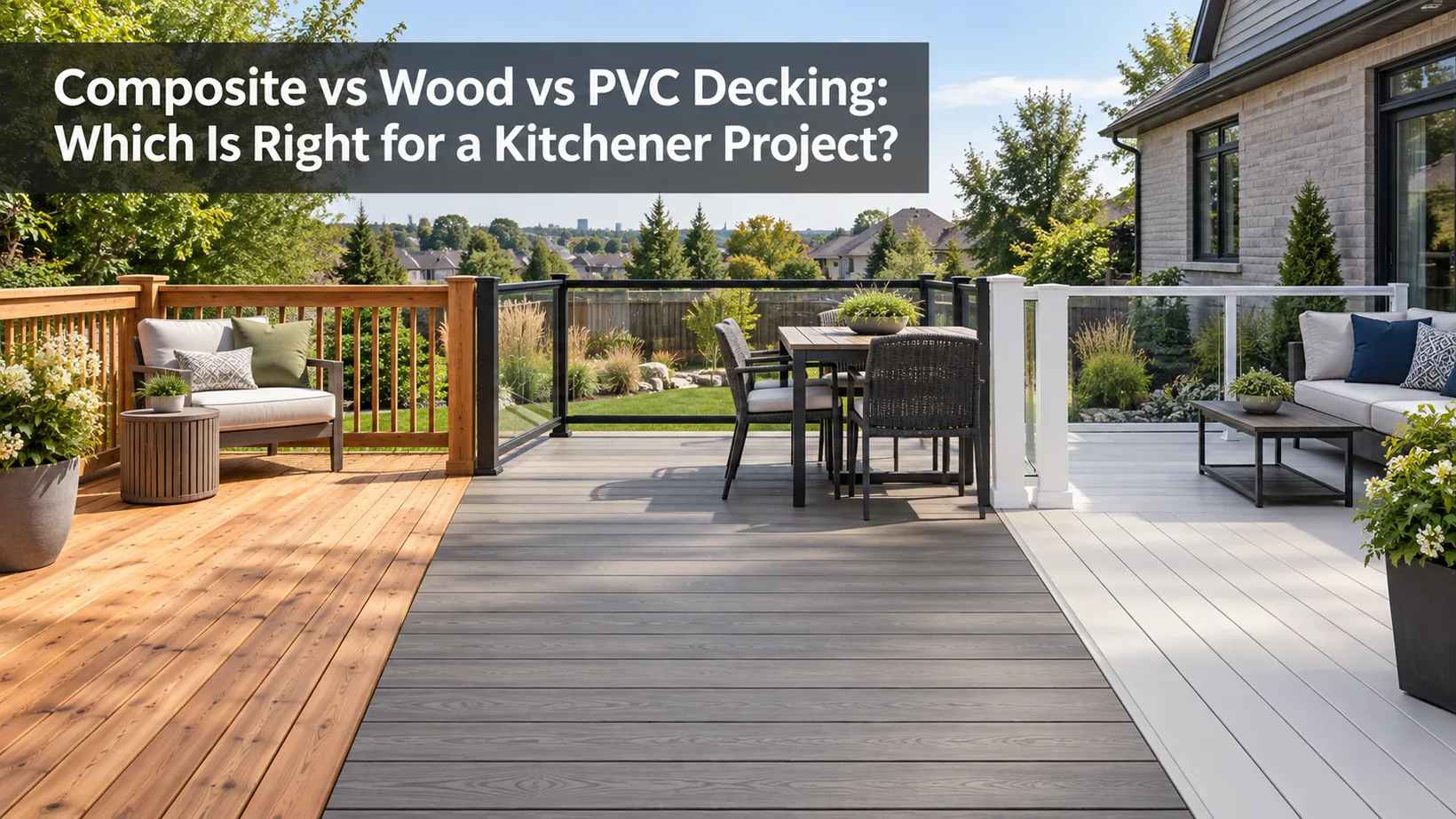
Composite, wood, and PVC solve different Kitchener deck needs. Wood offers natural texture and refinishing; composite reduces routine refinishing; PVC provides a fully synthetic surface. Compare them against one fixed deck design so surface and installation differences remain visible.
TL;DR
- Wood suits owners who value natural texture and accept cleaning and refinishing.
- Composite is worth pricing when less refinishing matters more than the lowest initial board cost.
- PVC deserves a close look where a synthetic surface and moisture-conscious design are priorities.
- Compare complete installed quotes, not board prices or generic cost-per-square-foot figures.
- Confirm the exact product and guard system against Kitchener's current acceptance guidance.
A material comparison becomes misleading when one proposal includes stairs, fascia, and railings while another prices only the walking surface. Ask every builder to quote the same footprint and features. Then the material difference becomes visible instead of being buried in a different project scope.
Compare the same deck three ways
Start with one dimensioned design. It should show the footprint, height at each grade change, stairs, support locations, railing runs, and any privacy or roof feature. Note whether demolition, electrical work, disposal, permit administration, and landscaping repair are part of the job.
Request three versions of that design: one with a specified wood surface, one with an exact composite collection, and one with an exact PVC collection. Keep the framing and other features equivalent where the products permit it.
When a material requires a different joist spacing, fastening method, or trim detail, show the difference openly. Kitchener's accepted-product guidance names specific decking collections, so verify the exact proposed product before treating the options as interchangeable.
| Decision | Wood | Composite | PVC |
|---|---|---|---|
| Surface character | Natural grain and variation | Manufactured wood-like or contemporary finishes | Synthetic board with collection-specific texture |
| Routine care | Cleaning plus finish decisions | Cleaning, with no routine wood staining | Cleaning, with no routine wood staining |
| Installation question | Treatment category, fasteners, and finish | Exact profile, span, gaps, and fastening | Exact profile, expansion details, span, and fastening |
| Budget question | What finishing work is included? | What trim and hidden fasteners are included? | What matching trims and installation details are included? |
The table describes material families, not a warranty or performance rating. Products within each column vary. A labelled sample, installation guide, and full proposal are more useful than a broad promise that one material lasts longer than another.
Which option costs less at the start?
Pressure-treated wood often has the lower initial board price compared with manufactured decking, but board price is not deck price. A low platform with no guard has a different cost structure from an elevated deck with stairs and a long railing run.
Site access and support work can outweigh the change in surface.
For a meaningful comparison, request separate line items for demolition, supports, framing, walking surface, fastening, border and fascia, stairs, guards, permits, site restoration, and taxes. Ask which items are fixed, which are allowances, and which are excluded. A named product collection belongs in the quote.
An allowance can hide a material difference. If the composite option has an allowance for railing while the wood option includes a finished guard, the totals do not answer the question. Ask the builder to replace placeholders with equivalent specifications before drawing a price conclusion.
Kitchener currently lists a $95 deck or porch permit fee on its residential building-permits page. That is a municipal application fee, not a complete approval or construction allowance. Check the City's current fee and whether the contractor's quote includes application preparation.
No credible local average can price your deck without its design and site conditions. If a proposal supplies a price per square foot, ask exactly which elements that unit covers. The denominator may be deck area while the expensive part is a staircase, a guard, or difficult access.
Compare ownership work, not a claimed lifetime
Wood's maintenance burden depends on the species, finish, weather exposure, and the owner's appearance standard. A wood deck can be cleaned and refinished, but the work does not arrive on a universal schedule. A shaded platform under trees needs different attention from a sunny, open one.
Wood Preservation Canada's pressure-treated lumber guidance says end tags distinguish above-ground from ground-contact use. That matters for the structure and any wood exposed to the ground, not just the visible board. Ask the builder to identify treatment categories in the material schedule.
Composite and PVC generally remove the recurring decision to stain the decking itself. They do not remove sweeping, washing, inspections, or care of the framing below. Food spills, leaves, planter moisture, and winter debris still need attention according to the exact product's care instructions.
Use a practical calendar rather than a claimed lifespan:
- Spring: clear debris, wash as directed, and look for standing water or loose components.
- After heavy summer use: address spills and examine areas beneath planters or outdoor rugs.
- Autumn: remove leaves from joints, stair corners, and the space beside the house.
- Before refinishing wood: follow the finish maker's preparation and weather requirements; do not assume a fixed annual cycle.
For cedar, the Western Red Cedar Lumber Association's deck-care guidance emphasizes drainage, debris removal, and drying beneath movable accessories. That advice is more useful than promising that cedar is maintenance free. For composite or PVC, request the selected manufacturer's current care sheet and keep it with the contract.
How Ontario exposure changes the result
Rain, snow, sun, shade, and repeated wetting do not automatically choose the material for you. They change the questions to ask. Where will water go after it reaches the deck? Can the underside dry?
Will snow collect beside a door? How will the homeowner clean the joints and the edge against the house?
On a heavily shaded deck, organic debris may remain damp longer. A manufactured board still needs cleaning; a wood board may also need closer attention to finish and ventilation.
Around a pool, inspect the product's wet-area guidance and the details of any railing or gate rather than assuming a surface label resolves the whole design.
What happens when a board needs repair?
Maintenance is not only a calendar of washing and finishing. Ask how an individual damaged board would be removed, matched, and replaced after installation. A visible-fastener layout may offer a different repair path from a concealed fastening system, and a discontinued colour can complicate matching on any manufactured surface.
For wood, ask whether a replacement board will be finished to blend with the older deck and whether a localized repair will remain visible.
For composite or PVC, ask whether spare boards of the exact collection and colour are available and whether the chosen profile can be replaced without dismantling a large section.
Keep the material schedule, installation instructions, care guide, and purchase record together. A future owner or repair contractor should be able to identify the actual product without guessing from its appearance. That small recordkeeping step can be more useful than a generic promise of durability.
Sunlight changes comfort and appearance. Dark boards of any material can feel hotter than lighter boards in direct sun. View a full-sized outdoor sample at the time of day when the deck will be used, and ask whether a shade element is part of the design or a later addition.
Snow removal deserves a care question too. Ask for the manufacturer's instructions for tools and de-icers on a specific composite or PVC collection. For wood, ask how the finish should be protected. Do not use a generic winter-care claim to override a product guide.
Look beyond the surface sample
A manufactured board may require a particular support spacing, fastener, edge treatment, or movement gap. Wood has its own treatment, connection, and finishing decisions. The contractor should identify the exact product and installation document, then show how those requirements appear in the drawings.
On Kitchener's product-acceptance page, approval attaches to named decking collections for low-rise residential use. It does not cover every board under a listed brand. The City also describes a review route for unlisted products. Confirm the collection and assembly before ordering.
Treat railings as a separate system. A wood walking surface does not require a wood guard, and a PVC walking surface does not make every synthetic guard acceptable.
Kitchener lists specific guard systems and has different documentation paths for unlisted systems. The visual match should follow the compliance decision, not replace it.
Check transitions from the field boards to steps and fascia. A sample can look convincing on a flat display yet produce awkward edges on a complex stair. Ask to see a completed stair and corner in the proposed material, preferably in a project with similar height and exposure.
When each material has the clearest fit
Choose wood when natural appearance, the option to refinish, and control over the initial surface specification matter most. Accept that appearance depends on a real cleaning and finish plan. Specify the wood type, treatment category where applicable, fasteners, and responsibility for finishing.
Choose composite when the household wants less routine refinishing and likes a particular manufactured look. Compare exact collections, not the word composite. Confirm the profile, fastening, support spacing, stairs, care document, and installed price.
Choose PVC when a fully synthetic walking surface fits the design, especially where repeated moisture exposure is an important concern. Evaluate the precise board's appearance, sun comfort, movement and installation details. Do not assume all PVC products perform or feel alike.
These are conditional fits, not a podium. The decision can reverse when the project includes an unusually long railing, intricate border, multiple levels, or a demanding site. The best surface for a simple platform may not produce the best complete proposal for a roofed outdoor room.
Decks by Premier can propose natural wood or specified composite and vinyl/PVC surfaces. If you request a proposal, ask its designer to price one consistent layout with clearly named alternatives.
Its design process is most useful here when the material comparison remains connected to stairs, guards, privacy features, and the way the deck meets the yard.
A quote-normalization test before you decide
Copy the following rows into a comparison sheet and use same, different, or not specified for each proposal:
| Scope row | What must be visible |
|---|---|
| Deck geometry | Same plan area, levels, stair count, and railing length |
| Structure | Support method, framing material, and product-required spacing |
| Surface | Exact wood specification or manufactured collection and colour |
| Edges and stairs | Fascia, borders, stair treads, risers, and fasteners |
| Administrative work | Permits, drawings, product review, and inspections |
| Closeout | Cleanup, site restoration, care instructions, and workmanship terms |
Only compare the material-price difference after every important row is either the same or deliberately priced as a difference. If a quote says “composite deck” without a collection, it cannot be reliably compared with an itemized PVC proposal.
Ontario's home-renovation contract guidance recommends written, itemized estimates and making the estimate part of the contract. It explains that an agreed change to scope or price should be documented. Apply that discipline before selecting a surface, not after a dispute over what was included.
For the final decision, ask yourself which task you are buying away. Wood may lower the first surface bill but asks more from the owner later. Composite and PVC may reduce refinishing yet require more exact product and installation checks.
The City list, the material's care guidance, and a normalized complete quote are stronger decision tools than a universal cost or lifespan claim.