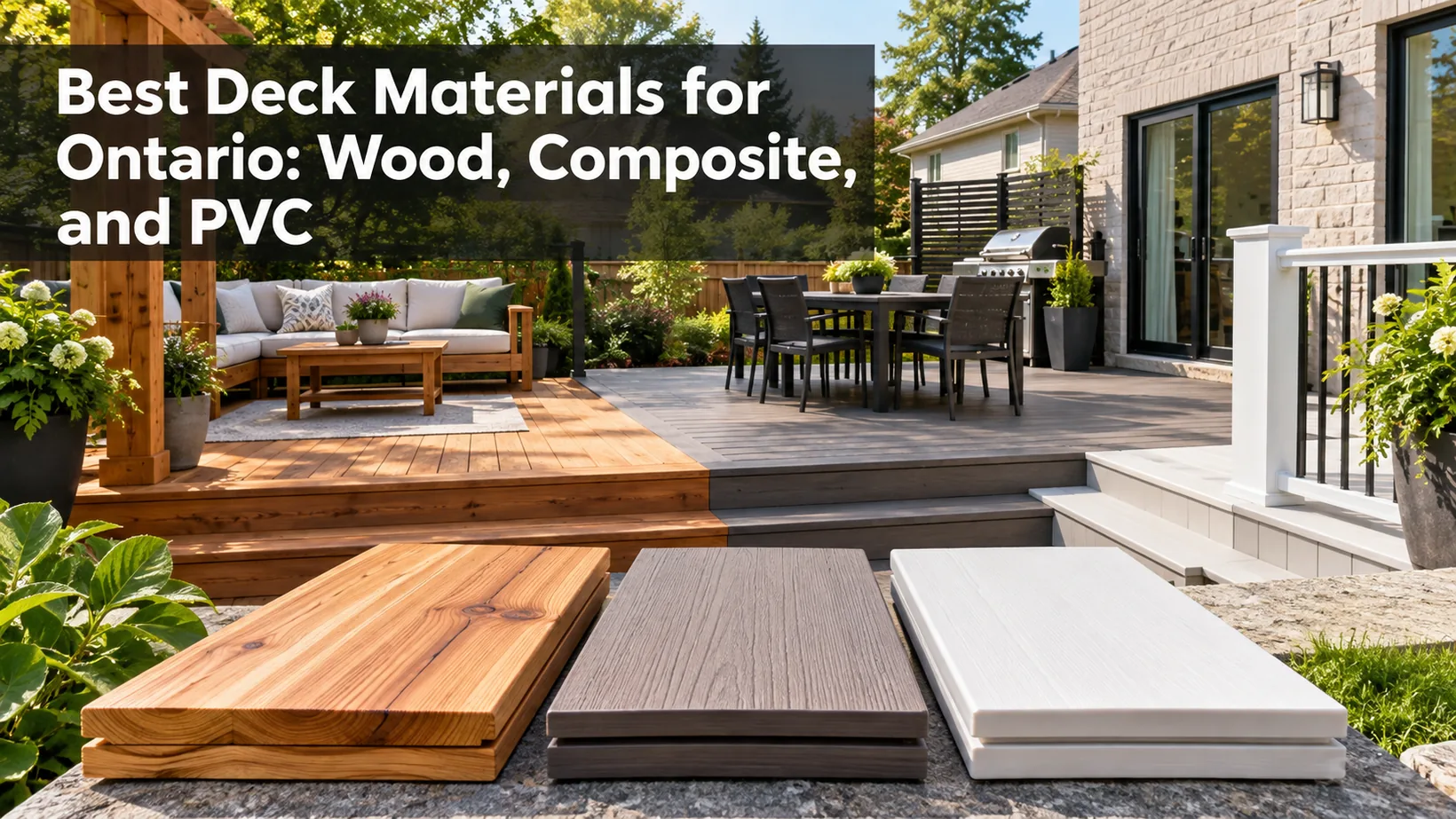
Best Deck Materials for Ontario in 2026: Wood, Composite, and PVC
TL;DR
- Choose pressure-treated wood when initial surface cost and a natural, finishable material matter most.
- Consider cedar for its appearance, with a realistic plan for weathering and upkeep.
- Consider composite when you want a wood-like look with less routine refinishing.
- Consider PVC when low water absorption is important, after checking the exact product, colour, heat, and fastening details.
- Kitchener lists accepted decking products for low-rise residential decks; confirm the precise collection before approving drawings or quotes.
The best deck material for an Ontario home depends on four linked decisions: how much upkeep you will do, what the site exposes the surface to, which appearance you want, and whether the exact product works with the proposed structure.
Wood rewards owners who value a natural surface and accept periodic finishing. Composite and PVC generally reduce refinishing work, but neither removes cleaning or product-specific installation requirements.
Start with the whole deck, not a board sample. The surface must work with the framing, drainage, fasteners, stairs, railings, and local approval path. A well-chosen board on an incomplete plan can still leave you with an awkward or costly project.
What does “best” mean for your deck?
Set the criteria before comparing samples. A household that will stain wood periodically can make a different choice from one that wants to sweep and wash the surface without refinishing. A sunny, uncovered deck asks different questions from a shaded landing near a pool or garden.
Use this short decision sheet at the first design meeting. Rate each item as essential, important, or flexible:
| Decision | What to ask | Why it changes the material choice |
|---|---|---|
| Upkeep | Will you clean and refinish, or mostly clean? | Wood and manufactured boards involve different maintenance tasks. |
| Appearance | Do you want real grain, uniform colour, or a specific texture? | Samples can look different outdoors than in a showroom. |
| Exposure | Is the deck shaded, wet, under trees, beside a pool, or in full sun? | Moisture, debris, and heat affect the everyday experience. |
| Budget | Is the budget for boards alone or the entire project? | Framing, stairs, guards, installation, and maintenance also cost money. |
| Product approval | Is the exact board accepted for the proposed use? | Local approval and manufacturer instructions govern the assembly. |
This is a decision aid, not a performance ranking. No one material wins every row. Ask to see the actual board profile and colour in daylight, then compare samples that meet the same project brief.
Pressure-treated wood: flexible and familiar
Pressure-treated lumber is a common choice when the homeowner wants a wood surface that can be finished or changed later. Its appearance and texture remain recognizably wood. The tradeoff is ongoing care: washing, inspection, and refinishing as the chosen coating and exposure require.
The treatment category matters. Wood Preservation Canada's residential building tips explain that end tags identify whether pressure-treated wood is intended for above-ground or ground-contact applications. The builder should specify the correct category for each component rather than treating every piece of treated lumber as interchangeable.
Cutting or drilling can expose untreated inner wood. Wood Preservation Canada advises field treatment of end cuts and drill holes with a suitable product. Ask the builder how that detail will be handled, particularly where connections are difficult to inspect after the deck is finished.
Pressure-treated wood can vary in tone, grain, and movement. Give the boards time and conditions appropriate to the finish manufacturer's instructions before staining. Ask which surfaces will be finished, whether finishing is included in the quote, and who will maintain exposed cuts and edges over time.
For a household that likes the look of real wood and accepts an ongoing maintenance routine, this can be the best value for the surface budget. It is a poor fit if the plan assumes the deck will never need cleaning, coating decisions, or inspection.
Cedar: natural character with visible weathering
Cedar appeals to homeowners who want a distinctive natural grain and colour rather than the more uniform look of many manufactured boards. Its appearance is the main reason to choose it, so view real outdoor examples rather than relying on a small indoor sample.
Exposure changes the look of any unfinished wood. If a consistent fresh colour matters, ask what cleaning and finishing programme the builder recommends for the exact cedar product. The Western Red Cedar care guidance calls for drainage, debris removal, and room for the deck to dry.
The quote should name the cedar species or grade, board dimensions, fastening approach, and finish plan. Do not assume a cedar surface means the entire structure is cedar. The framing and supports should be specified separately, with the correct products for their locations and use.
Cedar may be the strongest aesthetic choice for a design that celebrates natural material. The homeowner still needs to judge how much variation and maintenance is acceptable. A deck designed around a crisp, unchanged tone may be better served by another finish or a more explicit upkeep plan.
Composite: less refinishing, more product detail
Composite boards combine materials into a manufactured deck surface. Many current products use a protective cap, and collections differ in core composition, capping, profile, texture, colour, fastening, and installation instructions. The label “composite” tells you too little to approve a quote.
Composite is attractive when owners want a wood-like appearance without the routine sanding, staining, or sealing associated with many wood decks. It still needs cleaning, and leaves, food, grease, and standing debris should not be ignored.
Ask for the care document for the exact collection, not a general statement that it is maintenance free.
The City of Kitchener's accepted decking list names specific products for low-rise residential decks and says the list can change. A brand name alone does not confirm that every collection or board profile is included. If the proposed product is not listed, the City's page sets out a separate review route.
Ask the builder to show the board profile, matching fascia, stair treatment, and hidden or visible fastening method. Confirm how the selected product handles the desired layout, especially picture-frame borders, curves, and changes in level. Those details affect appearance and labour as much as the sample colour does.
Composite can be the practical middle ground for a homeowner who prioritizes lower refinishing work and a wood-like finish. The decision still depends on the exact collection, the installed assembly, and the price of the completed deck.
PVC: a synthetic option for moisture-conscious designs
PVC decking is a synthetic surface without the wood-fibre core common in many composite products. It can suit an owner who wants a low-maintenance surface and is especially attentive to repeated wetting around a pool, shaded area, or exposed platform.
Product design still matters; “PVC” is not a guarantee of identical performance across every collection.
Because PVC boards differ by manufacturer, ask for the installation guide, approved span and fastening method, stair detail, and cleaning instructions for the selected product. Have the builder identify how the board will meet railings, fascia, and any privacy or shade structure.
Colour and sun exposure matter to comfort. Any outdoor deck surface can become warm in direct sun, and a dark sample may feel different from a light one. Test the actual colour in a sunny outdoor setting when possible.
Do not accept an unqualified “cooler” or “slip proof” claim without product-specific conditions and supporting documentation.
PVC may be a good fit when the design calls for a manufactured surface with strong moisture resistance and the homeowner accepts its price and appearance. Compare it on the same completed-project basis as wood and composite, including stairs, trim, supports, and labour.
Ontario weather changes the details, not the basic choice
Kitchener decks experience rain, snow, freeze-thaw cycles, summer sun, and debris from nearby planting. The consequence is not that one board wins automatically. The consequence is that water movement, ventilation, fastening, cleaning access, and the correct structural materials must be designed together.
Ask what happens to snow and meltwater at the house connection and near a door threshold. Check where leaves collect, whether the space under the deck can dry, and whether the surface can be cleaned without trapping debris against walls or posts.
A poorly detailed deck can create problems regardless of its surface material.
The framing deserves its own line in the proposal. A premium board installed over inadequate or poorly specified framing is not a premium assembly. Ask the builder to identify the support system, joist spacing required by the selected product, drainage details, and any manufacturer conditions that affect the warranty.
If the project includes a permanent roof or an elevated platform, discuss permits and guard details before treating the surface sample as the final decision.
Kitchener says a deck needs a building permit if its height reaches 24 inches at any point or it has a permanent roof. The same municipal guidance describes drawings and product-review requirements.
Compare the full project, not only board prices
Request quotes that use the same footprint and feature list. Each proposal should name the surface product and collection, structural materials, support method, fastening system, trim, stair finish, railings, demolition, disposal, permits, site restoration, and taxes. Mark every line as included, allowed for, excluded, or unresolved.
The initial surface cost is only one part of the decision. Wood may demand more future labour and finishing materials. Manufactured boards may have a higher initial product cost and different installation details.
Without the complete quote and a realistic care plan, a price-per-board comparison can point to the wrong answer.
Treat warranties as specific documents. A manufacturer may cover stated material defects under conditions, while the contractor provides separate workmanship terms. Ask who registers the product, what installation records are kept, and how a future claim would be handled. A warranty headline is not the same as the coverage text.
Build a simple ownership estimate. Add the installed price you are actually quoted to the cleaning and finishing tasks you expect to perform over the time you plan to own the home.
Leave unknown future costs as ranges or questions. Do not pretend a universal lifespan or price schedule applies to every material.
Match the material to the household
Consider three common project briefs:
- Natural finish, controlled initial cost: pressure-treated wood may fit when the owner accepts periodic finishing and wants the ability to change the surface colour.
- Wood character as the design feature: cedar may fit when grain and natural variation are worth a specific upkeep plan.
- Less refinishing: composite or PVC may fit when the owner prefers manufactured boards and can compare exact collections, outdoor samples, and full installed prices.
For a complex deck with multiple levels, railings, privacy screens, or an outdoor structure, choose the surface after the layout and structural concept are credible. The material should support daily use without dictating an unsuitable layout.
Decks by Premier designs custom decks with wood, composite, and vinyl/PVC options. Its design and material-selection process can help a homeowner compare those choices within a complete outdoor-living plan. Ask for a side-by-side proposal using the same footprint and features, with the exact products and maintenance expectations written down.
The decision to make before approving the design
Pick the material that fits your actual upkeep tolerance, exposure, appearance preference, and complete project budget. Then verify the exact board, framing, fastening, care instructions, and local approval path.
Pressure-treated wood, cedar, composite, and PVC can each be a sound choice when their tradeoffs match the household and the assembly is properly specified.
Do not sign off on a generic material label. The finished proposal should let you identify the product, see how it will be installed, understand what you will maintain, and compare the full scope against another quote.
Kitchener's accepted-product list and Wood Preservation Canada's end-tag guidance provide two concrete checks for the selected surface and structural wood before the design is approved.